Three things this time: an oscilloscope on the Benches page, a firmware build, and a bigger instrument database in VisaMCP.
Eye masks on an HP 54845A
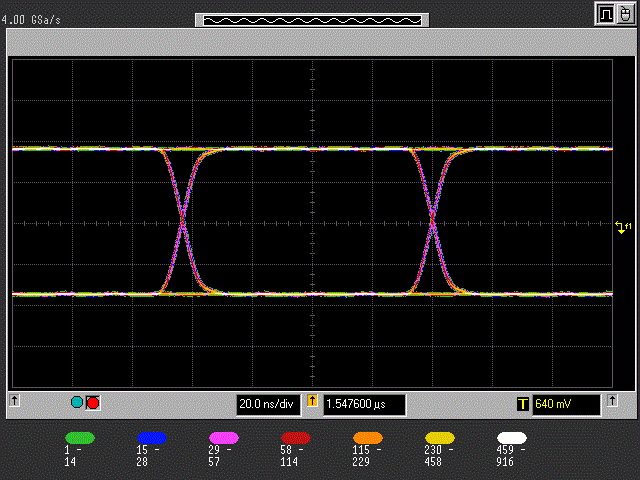
The HP 54845A Infiniium gets four front panels: measurements, per-channel settings, service, and the one that is actually interesting, Eye.
Eye is a mask test. Pick a protocol and the bench sets the scope up for it, vertical scale, timebase and trigger, and then loads the matching mask. Five masks come with it:
- USB full speed, 12 Mb/s
- USB high speed, near end (Template 1) and far end (Template 4)
- 10BASE-T Manchester
- 100BASE-TX MLT-3, which has two eyes rather than one
The eye builds up by accumulating acquisitions, each triggered on a data edge, with the mask covering one unit interval after it. Switch on infinite persistence and watch it fill in. The bench counts tested and failed waveforms and the hits inside the mask region, and resets those counters when you ask it to.
A word about the masks, because it matters more than the feature does. They are self-made. Two of them, the USB high speed pair, follow the templates published in the USB 2.0 specification. The other three are derived from the numeric limits in their standards, because no eye template exists for those signals. None of them are certification templates and none come with a promise of being right. They are go/no-go bench masks, useful for seeing at a glance whether a signal sits roughly where it should, not for saying a product passes.
One practical detail: mask files cannot travel over GPIB. Copy the five
.msk files into C:\scope\masks on the scope itself, over the
network, a USB stick or a floppy. Everything else the bench does for you.
Firmware V1.6.2610222113
On the Firmware Updates page. This build is mostly about the ++ protocol, the Prologix compatible mode. It had several issues, in replies, in status polling, in longer transfers and in what happened when a client disappeared mid-read. They are all addressed here, so if you use that mode, this is the build to be on.
Two changes in it are worth knowing about rather than just quietly fixing:
++llois new, for local lockout.++readwithout a parameter has changed. It now reads until the++read_tmo_mstimeout. If you want the old behaviour of stopping at EOI, write++read eoi.
The manual also changed its recommendation on resource strings: use
gpib0,<address> to reach an instrument and keep
inst0,<address> for R&S VISA. Section 8.2 has the detail, and
there is a FAQ entry about what goes wrong with Keysight IO
Libraries if the wrong one is used.
VisaMCP knows more instruments
VisaMCP has been updated and its built-in knowledge base now spans more than 1200 instruments. That is the part an assistant consults when it wants to know how a particular instrument identifies itself or terminates its replies. The same caveat as before applies: most of it comes from manuals rather than from a bench, so treat it as a starting point and not as gospel.